
U.S.S. Saratoga Shuttlebays & Support Craft
Created by Rear Admiral Zseeq on Thu Dec 25th, 2025 @ 11:24pm
Shuttlebays
Overview
Among the largest locations aboard a Federation starship, the Shuttlebays aboard the Intrepid II Class are massive, open areas assigned the task of launching the vessel's auxiliary craft. The Intrepid II Class incorporates two shuttlebays within its superstructure, with the Main Shuttlebay situated in the aft section of the Primary Hull.Managed by the Flight Deck Operations Officer, each Shuttlebay is constantly monitored and managed from its nearby control room. Landing procedures are closely managed, with the ship's computer assuming control of the craft during its descent into the bay. Runabouts, Shuttlecraft, and other auxiliary vehicles enter the Shuttlebay through an attached airlock door. Colossal in size, the exterior airlock doors are made of triple-layered duranium with an interior of lightweight neofoam sheeting in an expanded tritanium framework to support the massive structure. While the Shuttlebay doors are open, containment fields engage to maintain atmospheric integrity within the Shuttlebay.
Docking Bay
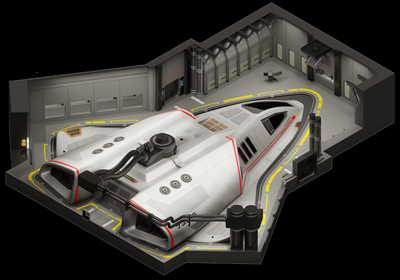 The Waverider III Docking Bay is a compact, specialized facility designed for the secure storage and rapid deployment of the Waverider III auxiliary craft. Located on Deck 12, the bay is engineered to function as both a hangar and a direct interface point with the U.S.S. Saratoga-C's primary systems. Unlike larger shuttlebays, this dedicated docking area provides a snug, controlled environment that ensures the craft is stabilized and fully integrated with the ship’s power, data, and life support grids immediately upon return.
The interior layout is highly specialized with the floor space dominated by the craft itself, surrounded by precision-guided landing tracks and maintenance umbilical access points. The bulkheads feature recessed lockers for mission-specific equipment, along with integrated terminals that allow the crew to monitor the yacht’s diagnostic status, atmospheric seals, and battery replenishment levels. The bay's design utilizes a modular containment system that locks the craft securely into place, allowing it to withstand high-stress maneuvering or combat operations without risk of displacement.
Safety and efficiency are prioritized through advanced sensor arrays that monitor the docking interface in real-time. Personnel access is provided through a centralized control station, which manages the docking sequence and maintains the integrity of the forcefield-shielded entry port. The environment is optimized for rapid turnaround, with automated loading arms capable of transferring cargo or supplies directly into the vessel's aft compartment. By providing this dedicated, highly refined docking environment, the U.S.S. Saratoga-C ensures that its primary auxiliary craft remains in peak operational condition for its various reconnaissance and diplomatic assignments.
Shuttlebay 1
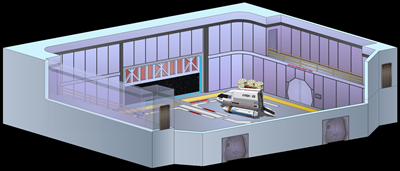 Shuttlebay 1, also known as the Main Shuttlebay, serves as the primary facility for the launch and retrieval of the Intrepid II Class starship's complement of auxiliary craft. Spanning across Decks 6 and 7, this critical operational center is engineered to ensure seamless flight deck operations for shuttlecraft, runabouts, and other specialized support vehicles. The facility is managed by Flight Deck Operations, with all movements closely monitored and coordinated from an integrated control room that oversees complex landing procedures, often relying on automated computer-assisted guidance and tractor beams to ensure safety during entry and egress.
The architectural design of the space emphasizes functional efficiency and safety. The outermost wall consists of a massive, triple-layered duranium pressure door, which provides access to deep space. To maintain environmental integrity during flight operations, specialized forcefield technology is deployed to prevent decompression while these exterior doors are open, allowing vessels to enter or exit while safeguarding the internal atmosphere. The bay floor is meticulously marked with landing guides and safety warnings to assist pilots during manual approaches, though automated systems remain the primary method for positioning craft.
The interior layout is optimized to keep deck space clear for active operations. Permanent and temporary storage for auxiliary equipment, cargo, and supplies is integrated into the bulkheads, ensuring the central floor remains unobstructed. The facility also features an elevated observation and control gallery, allowing deck personnel to monitor operations while maintaining a safe distance from active landing zones. The multi-level structure includes access points for personnel to reach the bay from the ship’s interior corridors, while designated maintenance zones allow for rapid servicing of shuttlecraft. Furthermore, the environment is brightly lit to enhance operational safety, with variable gravity zones clearly demarcated to notify personnel of hazardous areas. In emergency scenarios, the Shuttlebay is equipped with rapid deployment systems — such as concealed emergency nets integrated into the floor — designed to minimize damage to both the vessel and the craft in the event of a compromised landing. By combining high-capacity storage with sophisticated flight control and safety technology, the Main Shuttlebay remains a vital, high-functioning component of the Intrepid II mission profile.
Shuttlebay 2
 Shuttlebay 2 serves as a secondary, highly versatile support facility aboard the Intrepid II Class, designed to augment the operations of the main flight deck. While smaller in scale, this bay is optimized for rapid deployment and maintenance of scout-class vessels and utility shuttles. The facility is managed by Flight Deck Operations, with all procedures coordinated from an integrated control alcove that overlooks the deck floor. This space ensures efficient logistics for localized missions and provides redundant capability for launching or retrieving auxiliary craft should the primary facility be occupied or offline.
The architectural layout of Shuttlebay 2 emphasizes adaptability and security. Similar to the primary flight deck, the outer bulkhead incorporates high-strength pressure-containment mechanisms, including heavy-duty doors and forcefield emitters that maintain atmospheric integrity during egress. The deck is organized with clear, high-visibility landing markings and taxi guides that assist pilots in precision maneuvering even under adverse conditions. These markings are strategically integrated into the deck flooring, ensuring that shuttlecraft can be quickly serviced, reloaded, and prepped for flight without creating bottlenecks.
The interior is designed to maximize usable area through the use of modular storage lockers and maintenance conduits recessed directly into the bulkheads. This configuration keeps the landing floor unobstructed, allowing for the simultaneous handling of multiple auxiliary vehicles if required. Additionally, the bay is equipped with localized environmental control systems that can be adjusted based on the specific requirements of the docked craft. Safety remains a paramount feature, with reinforced hull plating surrounding the interior and emergency suppression systems ready to engage instantly in the event of a launch or recovery incident. By providing this dedicated, secondary operational node, the Intrepid II Class maintains a high tempo of mission readiness, ensuring that its auxiliary fleet can be deployed or recovered with maximum efficiency across a range of operational scenarios.
Support Craft
Captain's Yacht
Also known as the Captain's Gig, the Captain's Yacht is a secondary craft that is used at the discretion of the Commanding Officer. While capable of a variety of missions, the Captain's Yacht is normally used during diplomatic missions or to escort diplomats without the need for a transporter.
Waverider III Class
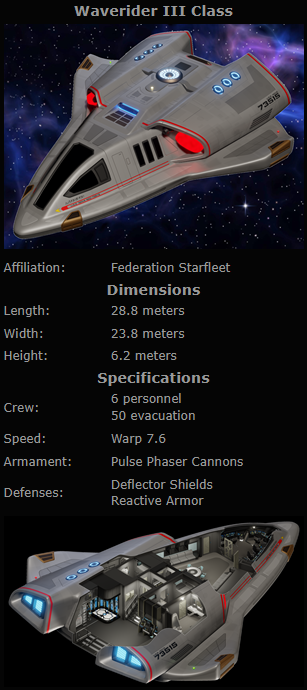 The Waverider III Class was engineered by Starfleet to serve as the premier multi-role auxiliary craft for the next generation of starships, replacing the Waverider II. Commissioned in 2436, the class was designed to operate as a modular platform capable of performing deep-space reconnaissance, tactical support, and diplomatic transport. The Zefram Cochrane is a prominent vessel of this class, currently serving as the integrated Captain’s Yacht for the U.S.S. Saratoga-C.
Overview
The Waverider III represents a significant leap in auxiliary vessel design, synthesizing the robust reconnaissance capabilities of the original Waverider line with the advanced Warp dynamics of the 2430s. Designed to rectify the limitations of its predecessors, the craft serves as a more versatile patrol and scout platform. While primarily configured for scientific exploration, it incorporates a Warp Propulsion System derived from recent breakthroughs in Warp Field stability and an enhanced weapons suite, allowing it to function as a formidable independent combatant when necessary. A key design achievement is its superior atmospheric maneuverability; the Waverider III utilizes next-generation aerodyne flight motors and adaptive aerodynamic surfaces, allowing it to operate within planetary atmospheres or the depths of gas giants with unprecedented stability.
Capabilities
The Waverider III is highly capable for short and medium-duration interstellar missions, boasting a Warp range exceeding that of previous runabout designs and supporting a standard crew of six for up to eight months without resupply. The interior prioritizes crew efficiency and comfort, featuring a modular forward flight deck, two modern staterooms, and a shared multi-purpose lounge suitable for recreation or formal diplomatic engagements. A large, reconfigurable aft compartment functions as a high-density laboratory or cargo hold, equipped with standard bio-filters and advanced replicator interfaces.The vessel’s atmospheric performance is enhanced by a specialized ramscoop built into its Impulse Propulsion System, which draws in reaction mass to enable near-indefinite flight time within gas giants or planetary atmospheres. For high-density or aquatic environments, the engine arrays and RCS thrusters utilize reinforced energy shielding, permitting limited, short-term submersion. Tactically, the yacht is protected by a reinforced deflector grid and modular, regenerative hull skinning. Its Pulse Phaser Cannons are integrated directly into the Warp Nacelle housing, providing excellent firing arcs for fleet support. In rapid deployment scenarios, the yacht can be launched from the Saratoga-C at speeds up to Warp 8, utilizing localized subspace field repeaters to ensure a safe, high-velocity transition to its own power.
Waverider III Class Vessels Assigned to the U.S.S. Saratoga NCC-31911-C | |||
| David Farragut | Docking Bay 1 | Named in honor of U.S.S. Saratoga Commander David Farragut. | |
Shuttlecraft
Shuttlecraft serve as the primary auxiliary workhorses of Starfleet, engineered to execute short-range and localized assignments that do not require the massive resources of a starship. Although they lack the expansive scale and long-term endurance of a Runabout, these vessels are fully warp-capable, allowing them to traverse the distances between neighboring star systems with ease. Their operational utility is centered on the efficient transport of cargo and personnel, as well as the delivery of away teams to planetary surfaces or orbital facilities. Due to their ubiquitous nature throughout the Federation, a standard lifecycle for these craft often involves a transition from active Starfleet service to civilian ownership; as the military fleet adopts newer, more advanced designs, the reliable shuttles of previous generations are frequently decommissioned and repurposed for private or commercial use.
Type 19 Shuttlecraft
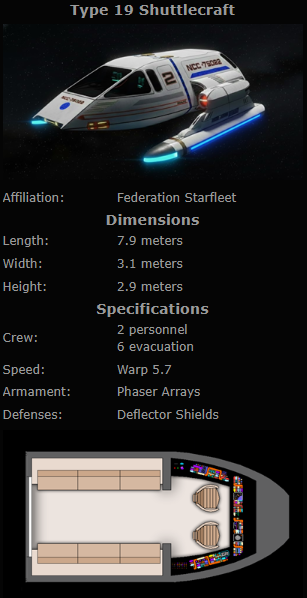 The Type 19 Shuttlecraft serves as a versatile, jack-of-all-trades support vessel designed for short-range away missions and interplanetary transport. Developed at the Oakland Shipyards, the Type 19 is the newest member of the historic Type 6 and Type 8 shuttlecraft families. Despite its advanced systems and newer production date, it remains a secondary choice within Starfleet, largely due to the specific design compromises necessitated during its development.
Overview
Drawing historical inspiration from the Rockwell Class C shuttle utilized during the 2250s, the Type 19 was intended to become the new standard flagship shuttlecraft for the fleet. Visually, the craft follows the "box-style" geometry of the Type 6 and Type 8 shuttle, a design choice made to ensure compatibility with existing Starfleet maintenance facilities, docking ports, and recovery platforms. The goal was to produce a robust, modular vehicle capable of meeting diverse mission profiles, similar to how the Type 8 updated the Type 6 with more powerful internal systems while maintaining an identical exterior footprint. However, much like the Danube-class development, the Type 19 was forced to reconcile ambitious technical goals with energy limitations, leading to the omission of several intended features, such as a high-output long-range reconnaissance sensor package. Nonetheless, the twin Navigational Deflector Dishes intended for the sensor package remain in the final product.
Capabilities
The primary technical achievement of the Type 19 is its spacious and highly customizable interior, which offers a significant volume increase over the six-meter Type 6. The internal layout features a forward cockpit with a horseshoe-pattern control console for two pilots, leading into a large cabin area that can accommodate up to eight passengers on bulkhead-mounted benches. Access is provided through a rear-folding hatch that doubles as an entry ramp. Unlike earlier models that often relied on the mothership for transport, the Type 19 is equipped with its own dedicated transporter system capable of beaming four individuals concurrently. For planetary operations, the craft utilizes an atmospheric airscoop and hover-field antigravs, allowing it to navigate and land on a planet's surface with the same aerodynamic ease as the venerable Class C and Type 6 models.The propulsion system of the Type 19 is an evolution of the Type 8’s Matter/Antimatter Warp Core. It utilizes inset Bussard Collectors and high-efficiency Warp Coils powered by dedicated reactors within the ventral nacelles. While the Type 19 can achieve high Warp velocities for emergency travel, its standard operational range is slightly less than the predecessors due to its energy profile. It is capable of short bursts of speed, but sustained travel at these velocities risks draining the field capacitors. If the energy reserves are depleted, the shuttle is forced to drop to sublight speeds for several hours to recharge, relying on its fusion-powered Impulse Drive and RCS Thrusters for maneuverability.
Defensively, the Type 19 features modular Phaser Arrays mounted on the Nacelle Pylons and caps, a configuration more advanced than the nose-mounted "chin-turret" Phasers. However, the energy draw remains a critical tactical consideration; firing these weapons in a combat situation places a severe strain on the central power core. Frequent use of the offensive systems can deplete the battery reserves, effectively disabling the Warp Drive until the systems can be replenished through the auxiliary Fusion Reactors. Despite these power management challenges, the Type 19 remains a sturdy and reliable asset for starbases and starships requiring a flexible personnel and cargo transport.
Type 19 Shuttlecraft Assigned to the U.S.S. Saratoga NCC-31911-C | |||
| Kyle Brody | 01 | Named in honor of Saratoga NV-20 Captain Kyle Brody. | |
| Margaret Sinclair-Alexander | 02 | Named in honor of U.S.S. Saratoga NCC-1887 Captain Margaret Sinclair-Alexander. | |
| Storil | 01 | Named in honor of U.S.S. Saratoga NCC-31911 Captain Storil. | |
| Maurice Vincenzo | 02 | Named in honor of U.S.S. Saratoga NCC-31911-A Captain Maurice Vincenzo. | |
Type 20 Shuttlecraft
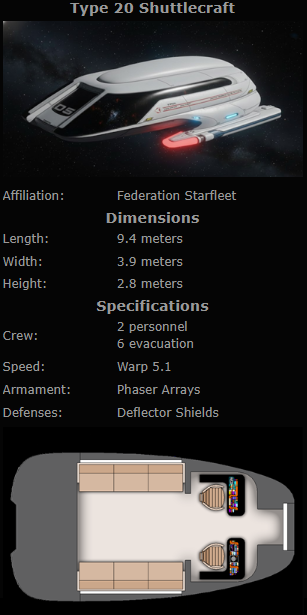 Launched in 2437, the Type 20 Shuttlecraft was engineered to fulfill specialist roles previously reserved for high-endurance runabout vessels. Manned by a crew of two technicians, this craft is capable of rapid reconfiguration for both cargo and passenger transport, making it a staple of Starfleet’s Department of Logistics. It has effectively replaced the aging Type 17 shuttlecraft in logistical support roles throughout the Federation, providing a bridge between standard short-range personnel carriers and larger mission-scout vessels.
Overview
While runabouts have dominated long-range survey duties since the 24th century, Starfleet Command identified a persistent need for a smaller, more agile craft capable of handling similar specialist assignments. To address this, Starfleet commissioned the engineers at the Baikonur Cosmodrome (the renowned design team behind the Type 7 Shuttlecraft) to develop the Type 20. The influence of the Baikonur design philosophy is evident in the Type 20’s aerodynamic profile, which evolves the rounded, fluid curves of the Type 7 "teardrop" hull into a modern, unibody shape. This design lineage emphasizes maximized internal volume and fluid atmospheric handling, traits that made the Type 7 a favorite for planetary search and survey operations during the mid-24th century.
Capabilities
Functioning as the cornerstone of Starfleet’s next-generation exploratory fleet, the Type 20 long-range shuttlecraft offers a substantial upgrade in mission endurance and versatility over the preceding Type 19. The craft’s layout begins with a two-person forward cockpit, which introduces a significant design departure: the primary ingress and egress hatch is integrated directly into the forward bulkhead. This allows for a more streamlined boarding process and leaves the remainder of the airframe dedicated to a massive, mission-configurable compartment. Separated from the flight deck by a heavy-duty pressure door, this internal space evolves the high-capacity cabin concept of the Type 7, which was renowned for its ten-passenger seating capacity.In the Type 20, this modular area is engineered for rapid adaptation to a wide spectrum of mission profiles. Standard configurations currently deployed include a high-volume cargo logistics bay, a personnel transport cabin featuring twelve seats and a self-contained lavatory, or a hardened Science Lab for conducting sensitive or hazardous research in isolation from the mothership. To further expand its operational utility, Starfleet is currently finalizing specialized ambulance modules for medical evacuation and tactical weapons compartments to provide localized defense on deep-space assignments.
The Type 20 is equipped with dual underslung Warp Nacelles featuring advanced variable geometry Warp Coils. This configuration allows for meticulous tuning of the subspace field, enabling the shuttle to reach a maximum velocity of Warp 5.1 and sustain Warp flight for up to 36 hours. Placing the engines in an underslung position optimizes the craft’s center of mass and provides superior stability. Despite these propulsion breakthroughs, the Type 20 remains susceptible to the energy management hurdles that historically plagued the Type 7, as the power demands of specialized mission hardware often compete with primary flight systems. To mitigate the risk of losing life support or propulsion during a tactical engagement, the shuttle utilizes dedicated internal power packs to drive its offensive systems independently of the main reactor. While it is significantly better armed than its Type 7 predecessor (which lacked standard weaponry and required specialized refits for basic phaser capability) the Type 20’s defensive profile is still specialized, typically necessitating an armed escort for operations deep within hostile or uncharted space.
Type 20 Shuttlecraft Assigned to the U.S.S. Saratoga NCC-31911-C | |||
| Ospak | 01 | Named in honor of U.S.S. Saratoga NCC-31911-B Captain Ospak, killed at the 250th Frontier Day. | |
| Ratith | 02 | Named in honor of U.S.S. Saratoga NCC-31911-B Captain Ratith, killed in a docking incident. | |
Shuttlepod
Shuttlepods are small craft that are typically assigned to short-term assignments within close distance to their mothership. Incapable of interstellar voyages, Shuttlepods typically lack faster-than-light propulsion systems and weapons and are used for close range transport when the Transporters are unavailable.
Type 25 Shuttlepod
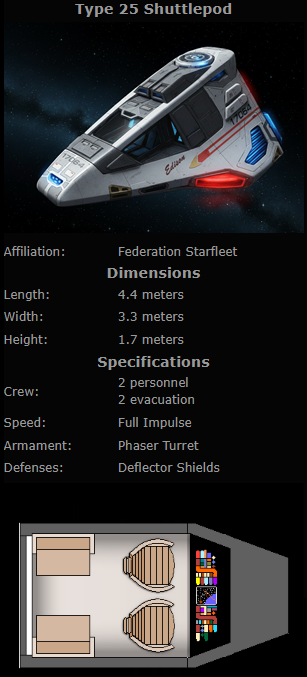 The Type 25 Shuttlepod was engineered as the direct successor to the Type 18, serving as Starfleet’s primary next-generation vehicle for orbit-to-surface transfers. Heavily influenced by the successful Flyer Class runabout of the 24th Century, this compact craft provides significantly expanded operational range for moving personnel and small materiel between nearby habitats, planets, and space stations. While maintaining its role in congested orbital environments, the design now incorporates a limited Warp Drive, allowing it to reach speeds up to Warp 2.3.
Overview
The Type 25 Shuttlepod was designed and constructed at the Bajoran Okana Shipyards, a facility becoming well known for its specialized work on auxiliary craft. It follows the lineage of the Type 15 shuttlepod, which was famously utilized aboard Galaxy Class starships for tasks involving the transport of unstable materials or navigating hyperonic radiation that would otherwise scramble Transporter beams. While it features modernized subspace communications and updated computer systems, the shift to a Warp-capable architecture allows it to operate independently of a mothership for extended local missions.
Capabilities
The interior of the Type 25 consists of a single pressurized compartment, accessed via an airlock integrated into the aft bulkhead. In its standard configuration, the craft is operated by a single pilot, though a horseshoe-pattern control array allows for a second systems manager if the assignment dictates. The seating is highly modular with flip-down passenger seats available in the small cargo area behind the primary navigational controls. Once docked via its universal docking port, the pod’s life support and reaction control fuel are automatically replenished by the parent vessel.While previous iterations relied strictly on high-output impulse, the Type 25 now incorporates a compact Warp Propulsion System. This system allows the craft to operate as a self-contained unit during short-range interstellar hops. Despite this upgrade, the Type 25 retains superior handling within planetary atmospheres, utilizing an atmospheric ramscoop to superheat intake air for sustained flight within a wide range of environments. For defense, the Type 25 is equipped with a single Phaser turret powered by an independent battery system. In extreme scenarios, the craft maintains a constant data link with its mothership, allowing for rapid extraction or tactical support from the starship’s primary tactical arrays.
Type 25 Shuttlepods Assigned to the U.S.S. Saratoga NCC-31911-C | |||
| William F. Halsey | 01 | Named in honor of U.S.S. Saratoga CV-3 Captain William F. Halsey. | |
| Amelia Hawkins | 02 | Named in honor of U.S.S. Saratoga LHA-15 Captain Amelia Hawkins. | |
| Robert Stroh | 01 | Named in honor of U.S.S. Saratoga CV-60 Captain Robert J. Stroh. | |
| Harry Yarnell | 02 | Named in honor of U.S.S. Saratoga CV-3 Captain Harry Yarnell. | |
Categories: No categories found