
U.S.S. Saratoga Medical & Scientific Facilities
Created by Rear Admiral Zseeq on Wed Dec 31st, 2025 @ 5:21pm
Medical Facilities
Sickbay
 The U.S.S. Saratoga-C features a highly advanced, next-generation medical complex designed to meet the demands of deep-space exploration. Located in the center of Deck 7, Sickbay is structurally positioned near the vessel's Shuttlebay, ensuring the rapid transport, triage, and quick treatment of patients arriving from away missions or hazardous planetary environments. In line with emergency contingency protocols, the adjacent Shuttlebay can be rapidly converted into secondary triage centers using quick-deploy emergency hospital modules during large-scale disasters or humanitarian crises.
The structural layout of the facility marks a significant evolution in Starfleet medical design. Incorporating crucial historical feedback from the original U.S.S. Voyager's Chief Medical Officer, this next-generation facility actively departs from traditional open-ward floor plans to place a profound emphasis on patient comfort and privacy. Rather than a single open ward with exposed biobeds, the main treatment section features individualized patient care alcoves separated by partition walls, structural bulkheads, and privacy fields.
Positioned along the primary corridor, the Main Ward contain five orthopedically designed diagnostic biobeds equipped with sophisticated internal sensor arrays. These sensors seamlessly track real-time physiological data (including heart rate, neural activity, and core vitals) transmitting them directly to regional monitors, handheld PADDs, or medical tricorders. Unlike prior Sickbay designs, a twin patient Surgical Bay is housed elsewhere in the complex and features an overhead cluster of advanced diagnostic biofunction sensors capable of gathering precise subcellular data. For invasive or critical procedures, the bed integrates a specialized Surgical Support Frame (SSF), or "clamshell". The SSF projects a localized containment field and engages an independent environmental system to ensure total sterilization against hazardous microorganisms while automating intravenous medications, cardiovascular resuscitation, and regenerative field therapy.
Placed centrally within the floor plan, the Nurse's Station serves as an administrative hub featuring priority linkages to the main computer core and the Starfleet Medical Database, allowing on-duty personnel to constantly monitor every active biobed simultaneously. A series of consultation offices are available - which include a large consultation desk, visitor seating, a replicator, and a dedicated wall-mounted display - are available for private conversations between doctor and patient. Located adjacent to the Surgical Bay, the Chief Medical Officer's Office is the largest compartment in this suite of offices.
The Saratoga-C is uniquely optimized for the treatment of non-class-M lifeforms and exotic species native to unexplored regions. Situated in a dedicated, isolated alcove near the main entrance, the specialized Alien Environment Treatment ward features an independent biohazard isolation unit and its own environmental controls. This allows physicians to alter atmospheric pressure, gravitational vectors, and gas mixtures to match a non-humanoid patient's native homeworld without impacting the rest of the facility. A hologrid installed in this area allows for the creation of any environment, and allows for the creation of holographic specialists to assist in treatment as needed.
For maximum containment security during first-contact medical crises, this alien treatment zone is serviced directly by an onboard Emergency Transporter pad and an integrated Sterilisation Arch. This infrastructure allows highly contaminated or fragile extraterrestrial patients to be beamed directly into a controlled environment, instantly passing through decontamination forcefields without exposing the rest of the ship's company. To support long-term deep-space research, the complex boasts significantly expanded Medical Lab space connected to the main ward. Outfitted with advanced bio-assay hardware, genetic sequencing tools, and virotherapeutic equipment, this section provides dedicated workstations for chemical analysis, real-time medication synthesis, and multi-dimensional lifeform analysis.
Emergency Medical Holographic Program
 The Emergency Medical Hologram Mark IX represents the apex of Federation holographic medical integration, succeeding the widely criticized Mark I through IV series and the more specialized Mark V through VIII Medical Holographic programs. Engineered in 2438, the Mark IX was designed to move beyond the clinical coldness of the Zimmerman-based templates. Following the decommissioning of prior EMH series, the Mark IX was designated as the standard emergency medical supplement for the fleet. To achieve a superior bedside manner and intuitive diagnostic capability, the design is highly configurable and the matrix can be modified to any number of preprogrammed templates.
The Mark IX is powered by a high-density multitronic heuristic matrix featuring a memory capacity exceeding 75 million gigaquads. Unlike earlier models restricted by a 1,500-hour operational limit, the Mark IX utilizes a stable Read and Write pathway that allows for indefinite continuous operation without matrix fragmentation. The program integrates over six million medical protocols, drawing from the collective knowledge of 3,500 Federation and non-aligned cultures. It includes specialized subroutines for Xenobiology, Comparative Alien Physiology, and psychological trauma management. Despite the advanced holographic nature of the Mark IX, it is programmed with a deep-seated reverence for the Hippocratic Oath and is capable of overriding command authority if a direct order involves the intentional harm of a patient under its care.
Physical manifestation is achieved through advanced magnetic containment fields and high-resolution tactile subroutines, allowing the Mark IX to perform micro-surgical procedures with a variance of less than 0.001 micrometers. To optimize processing cycles, the hologram is rendered as a hollow electromagnetic shell with no internal organs. The program can manually or automatically adjust its density from absolute solidity to total intangibility, allowing the Mark IX to function within high-radiation zones, toxic atmospheric leaks, or vacuum-exposed compartments to reach casualties.
A significant advancement of the Mark IX is its ship-wide utility. Modern Starfleet vessels equipped with deck-wide holoemitter arrays allow the Mark IX to be projected outside of the Sickbay environment. The program is hard-wired into the ship's main computer and internal sensor grid, enabling it to auto-initiate at the site of an injury upon the declaration of a Red Alert or the detection of a "Code Blue" medical emergency. When active, the Mark IX monitors the Emergency Medical Channel and the ship’s internal communications. This allows the program to provide real-time verbal guidance to first responders before it can be physically projected to the location.
Scientific Facilities
Arboretum
 The Arboretum aboard the U.S.S. Saratoga-C is a botanical garden composed of trees and shrubs from a variety of worlds. Unlike the singular, expansive facilities found on larger explorer craft, the Saratoga-C’s Arboretum is segmented into two dedicated sections located on the port and starboard sides of Deck 12. While smaller than those on capital-scale vessels, these spaces remain vital to the ship's internal ecosystem.
The Arboretum serves multiple functions, acting as both a recreation area for crew relaxation and a hub for ongoing scientific research. Due to the dense variety of plant life within the compartments, the Arboretum actively supplements the Saratoga-C’s life-support systems and assists in maintaining atmospheric quality throughout the craft.
New personnel are frequently given a tour of these facilities by their respective Department Heads. Designed with an open-space plan to emphasize low-intensity recreation, the Arboretum features rustic trails, benches, and specialized lighting arrays. Both port and starboard wings feature a central, compact water feature and house diverse collections of flora, including several endangered plant varieties preserved for ongoing study.
Laboratory (Configurable)
 Intrepid II Class starships, such as the U.S.S. Saratoga-C, are equipped with twelve general-purpose Science Laboratories. Each laboratory is designed to facilitate either experimental or observational science, providing personnel with controlled environments for scientific and technological research, experiments, and measurements. Due to their modular design, each laboratory is capable of concurrently executing multiple investigations with minimal risk of interference.
Due to the critical nature of these operations, multiple safeguards are integrated to protect the ship and crew from research projects that may become hazardous. Each laboratory features a dedicated life-support connection and can be isolated from the rest of the ship's systems in an emergency, such as in the event of a viral outbreak. Forcefield generators installed within the bulkheads allow for the immediate isolation of an individual laboratory should a threat emerge. If a biological lifeform escapes experimental confinement, anesthetic gas can be deployed for containment. In extreme circumstances where all other containment options are exhausted, the laboratory can be vented into space.
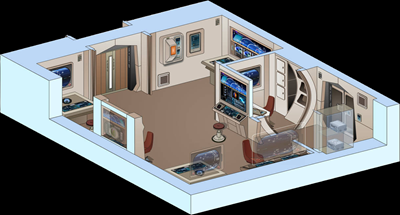
Starfleet Sciences has authorized five basic laboratory compartment designs for usage aboard the Saratoga-C. While specific equipment access varies between designs, each laboratory contains basic equipment ubiquitous to the class. Every laboratory includes a large analysis table for detailed subject examination, which can be further isolated from the lab via an internal forcefield during emergencies. Multiple workstations are fitted throughout the space for use by technicians, with most terminals built directly into the bulkheads and some incorporating secondary analysis tables to supplement the primary unit. Additionally, multiple storage compartments located around the periphery of the room house the necessary equipment and supplies for scientific study.
Laboratories in Use on the U.S.S. Saratoga NCC-31911-C | |||
| 1 | |
None | Anthropology & Archaeology Laboratory General Science Laboratory |
| 2 |  |
Large Holographic Tank | Astrophysics/Physics Laboratory Planetology Laboratory |
| 3 | 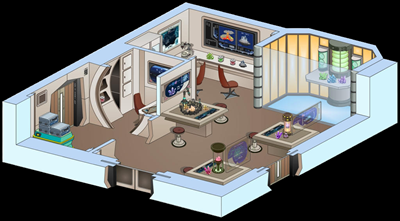 |
Isolation Room | Botany Laboratory Chemistry Laboratory Geology Laboratory Machine Shop Metallurgy Laboratory |
| 4 | 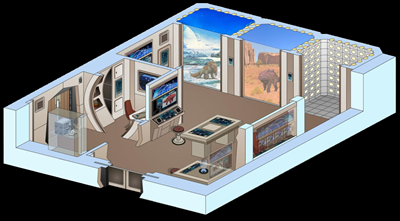 |
Multiple Holographic Observation Cells | Biology/Xenobiology Laboratory Zoology Laboratory |
| 5 | 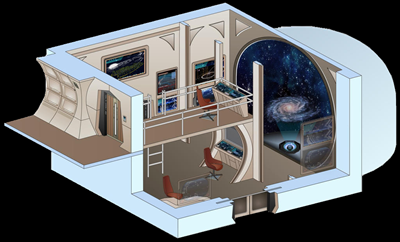 |
Large Holographic Tank Multi-Level |
Stellar Cartography |
Library
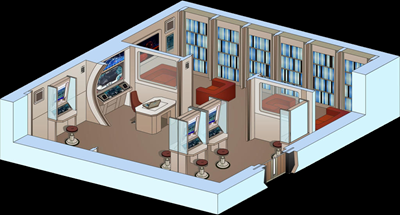 The Library aboard the U.S.S. Saratoga-C is located on Deck 18 in the Engineering Hull. It is used for research purposes, supporting scholarly or scientific investigation aboard the vessel. Providing access to both physical and digital materials, including a collection of printed reference materials that may be utilized inside the premises, the Library offers a variety of options for researchers to obtain needed information.
 Due to the ease of access to information within the galaxy, many may not know how to fully utilize library resources, which may impact usage. To combat this, the Library is staffed by a Librarian, a specially trained research professional, to assist with research needs. To facilitate learning, the Library provides quiet space for private studying, common areas to facilitate group study and collaboration, and dedicated workstations allowing access to electronic resources through the Library Computer and the Starfleet Galactic Memory Bank at Memory Alpha.
The facility’s layout incorporates a dedicated Librarian’s office and workspace to assist researchers, multiple private study booths with glass partitions for focused work, and an extensive perimeter of floor-to-ceiling shelving housing physical reference materials. The central area features an open floor plan with various electronic study stations and comfortable seating, all optimized for scholarly collaboration and private study.
Categories: No categories found