
U.S.S. Saratoga Secondary Locations
Created by Rear Admiral Zseeq on Wed Dec 31st, 2025 @ 6:21pm
Auxiliary Control
 Located on Deck 16, Auxiliary Control serves as the secondary command center aboard the Intrepid II Class U.S.S. Saratoga-C. While this facility is more compact than the vessel's Bridge, it is engineered for high-performance tactical operations, featuring simplified versions of the essential workstations found on the Main Bridge. This supplemental command center is designed to ensure the starship can be fully operated from a single, reinforced location in the event that the Bridge or Main Engineering sections are incapacitated.
The room's layout is centered around a Command Chair for the duty officer, providing a clear vantage point of the entire compartment. Directly ahead of the Command Station is a highly integrated Flight Control and Operations workstation used for piloting the vessel and managing primary systems. The bulkhead features an expansive, multi-panel Tactical console that allows for comprehensive monitoring and control of sensors, weapons, and defensive arrays.
To maintain the ship's security, entry to Auxiliary Control is restricted and verified through mandatory biometric scans, ensuring that only authorized personnel can access the command systems. Because the Saratoga can be completely controlled from this facility, the auxiliary center is outfitted with localized power relays and independent communication arrays, ensuring sustained combat readiness or navigational control even during catastrophic ship-wide system failures.
Cargo Bay
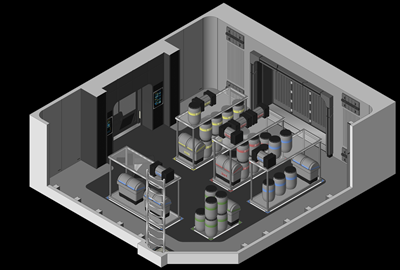
The Cargo Bay, also referred to as a Cargo Hold, serves as the general-purpose storage facility aboard the Intrepid II Class U.S.S. Saratoga-C. Distributed across the vessel, these bays are primary hubs for managing mission-critical goods, planetary deliveries, and the ship's internal stores. Due to their expansive and modular nature, they are designed for rapid conversion during emergencies, frequently serving as secondary triage centers, temporary brigs, or specialized stasis unit facilities.While the Saratoga-C utilizes its primary Transporter Rooms for high-capacity transit, several cargo bays are equipped with dedicated cargo transporters to facilitate the direct transfer of supplies at a molecular resolution. Many of these facilities feature large atmospheric force-field-protected doors that open directly into space, allowing workbees and shuttlecraft equipped with cargo management units to enter the bay for immediate offloading. For internal logistics, personnel utilize anti-gravity units and localized tractor beam generators to maneuver heavy containers with minimal effort. A sophisticated cargo conveyor system further optimizes efficiency by connecting the forward holds to those in the aft sections of the ship.
 |
 |
Computer Cores
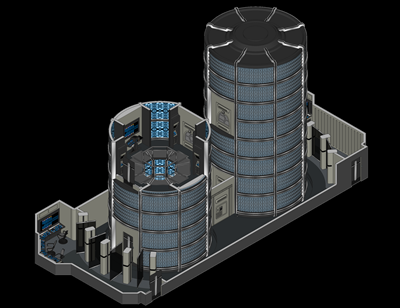 The U.S.S. Saratoga-C utilizes a sophisticated computing architecture centered on a dual-core system. This configuration serves as the ship's central nervous system, overseeing all operations ranging from library computer access to complex tactical calculations. Unlike the prototype cores currently being tested on the Century Class, the Saratoga-C architecture integrates second-generation bio-neural circuitry, offering enhanced processing speeds and adaptive decision-making capabilities.
The computer core assembly features two primary processing cylinders situated in parallel within a reinforced engineering vault. This dual-core design is critical for redundancy; it allows one core to be taken offline for a total system reset or software patch while the other maintains all critical ship functions without a loss of service. The cores are cross-linked via high-speed optical data trunks, ensuring that the ship’s systems can share data instantaneously or operate independently if necessary.
The assembly is surrounded by a maintenance gallery, allowing technicians to access individual processing slices for hardware upgrades or repairs without taking the entire system offline. A dedicated monitoring console is located within the access room, providing real-time telemetry on processor heat levels and data throughput. By utilizing this dual-core arrangement and advanced bio-neural hardware, the Saratoga-C ensures continuous operation and peak performance during both routine missions and significant technical overhauls.
Bio-Neural Gel Pack
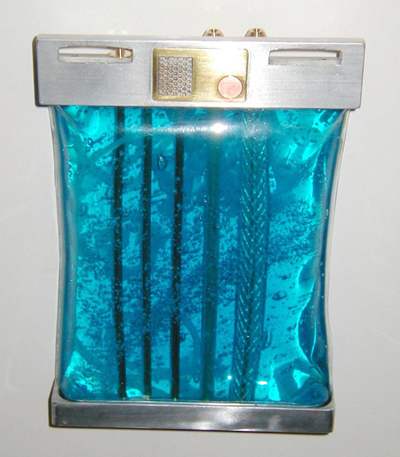 The U.S.S. Saratoga-C utilizes second-generation bio-neural gel packs, building upon the groundbreaking technology first introduced on the Intrepid Class. These advanced computer components combine traditional isolinear circuitry with synthetic neural fibers suspended in a nutrient-rich biomimetic gel. By mimicking the architecture of the humanoid brain, these gel packs allow the ship's computer to organize information efficiently and perform complex procedures at extremely high speeds.
Unlike standard isolinear chips that rely on exhaustive calculations, bio-neural gel packs utilize a "best-guess" decision-making process, enabling the ship to compute optimal course corrections in real time. Each pack consists of a flexible, transparent casing containing the organic medium and a metallic interface bar, allowing them to be swapped as easily as conventional isolinear chips. These units form a network comparable to a nervous system throughout the ship, with primary functions including instantaneous navigational computations.
Because these systems utilize organic components, they are vulnerable to viral infections and can essentially become "sick". Unlike the original units, the second-generation gel packs aboard the Saratoga-C feature enhanced processing speeds and adaptive decision-making capabilities, maintaining the Intrepid II Class at the forefront of Starfleet computing. When necessary, medical staff can treat infected gel packs using conventional medicine, such as simulating a fever to destroy invasive bacteria.
To address the biological vulnerabilities demonstrated by first-generation architectures, the Saratoga-C’s secondary network features localized isolation fields and automated micro-sterilization conduits integrated directly into the gel pack housing bays. These safeguards allow the main computer to automatically quarantine compromised gel packs the moment abnormal biological activity or bio-resonant degradation is detected, preventing systemic infections from spreading across the primary processing cores. Furthermore, the synthetic neural fibers have been engineered with broad-spectrum bio-synthetic antibodies, providing a self-sustaining immune layer that neutralizes common airborne microbes and radiation-induced cellular mutations before they can degrade core processing speed.
This second-generation integration also drastically refines how the vessel manages high-stress tactical and environmental variables. By operating in tandem with the Saratoga-C’s primary mainframes, the bio-neural network creates a fluid, intuitive interface between sensor telemetry, impulse manifold adjustments, and defensive shield modulation. Rather than processing each sensor ping and power draw sequentially, the gel packs dynamically re-route sub-routines based on predictive combat telemetry and real-time hull stress, granting the bridge crew instantaneous response times during critical operations in volatile deep-space environments.
Tactical Facilities
Armory
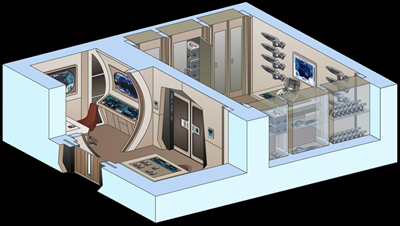 The Armory aboard the Intrepid II Class U.S.S. Saratoga-C serves as the high-security staging and storage hub for the vessel's personal weaponry and tactical equipment. Designed for rapid response and efficiency, the facility is divided into two distinct functional zones separated by a structural bulkhead and heavy security doors. The primary administrative area features an L-shaped monitoring console where a Security Officer manages the armory's inventory and monitors ship-wide tactical sensors. This section is equipped with several wall-mounted displays and a dedicated workstation, ensuring that the Armory remains a focal point for internal defense operations.
Adjacent to the duty station is the primary storage vault, a reinforced compartment containing rows of specialized glass-fronted cabinets and open-access wall racks. These units are meticulously organized to house a wide array of Starfleet-standard equipment, including hand phasers, phaser rifles, and related weaponry. The facility also features vertical storage lockers for environmental suits and heavy-duty combat gear, ensuring that away teams can be fully equipped for any planetary or boarding contingency. For added security, a localized forcefield generator and biometric verification systems are integrated into the vault's entrance to prevent unauthorized access to the lethal ordnance contained within.
Brig
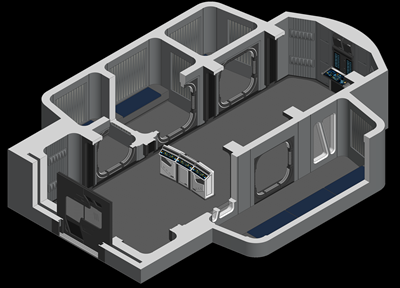 The Brig on the Saratoga-C serves as the primary detention facility within the Security Section, designed to house criminals, fugitives, or individuals deemed a danger to themselves or the ship’s complement. Heavily guarded and strategically segregated from the ship’s primary habitation hubs, the Brig is engineered for total containment and maximum surveillance.
The Brig is a single-level facility featuring a central corridor that separates the various detention units. A primary security console is positioned in the center of the room, parallel to the main entrance, allowing the duty officer to manage the advanced security sensors that monitor each occupant's vitals and threat level in real-time. This console also controls the internal forcefield arrays and atmospheric regulators for the entire suite. The structural layout includes three individual cells located on the port side of the room, while a single, elongated holding cell is situated on the starboard side to accommodate groups of prisoners or high-volume transfers.
The cells are functionally designed, prioritizing security over comfort, and are constructed with rodinium-reinforced bulkheads to withstand any physical escape attempts. Each cell contains a single bunk integrated directly into the bulkhead, serving as the sole concession for prisoner comfort. Forcefield generators are embedded into the cell door frames, creating an impenetrable barrier that is managed via a dedicated keypad interface built into the surrounding bulkhead for localized control by security personnel.
Torpedo Bay
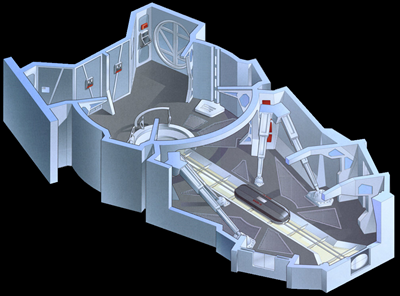 The Torpedo Bay aboard the Saratoga-C serves as the primary storage and deployment hub for the vessel's photon and quantum torpedo complements. These bays are highly automated facilities, though they retain the capacity for manual overrides and physical modifications to the launchers if automated systems fail. The structural layout of the bay is characterized by a long, narrow configuration designed to facilitate the rapid movement of ordnance from the storage magazines into the primary launching mechanisms. To ensure the survival of the ship's offensive capabilities during combat, each bay is heavily reinforced by the vessel's primary armor plating.
Within the bay, torpedoes are lowered into the loading area where personnel can perform final diagnostic checks or warhead calibrations before the launch sequence initiates. Once prepared for deployment, the torpedo is transferred onto a launch track recessed into the deck plating, which guides the unit toward the forward or aft launch tubes. The launching system utilizes a series of articulated mechanical arms to precisely position the ordnance within the tube assembly. This assembly is separated from the main bay by an inner pressure door designed to shield the crew from the intense plasma exhaust generated by the torpedo's propulsion systems. When firing, the outer hull doors retract, allowing the torpedo to be propelled from the tube toward its designated target.
Current torpedo ordinance on Saratoga includes:
- Phased Plasma (Phoenix) Torpedo: The least abundant experimental weapon on Saratoga, the Phased Plasma Torpedo is designed to bypass defensive grids by becoming semi-intangible, though it remains in development due to previous stability issues and power limitations.
- Photon Torpedo: The most abundant heavy weapon on Saratoga, the Photon Torpedo utilizes matter-antimatter annihilation to deliver explosive yields and serves as the primary tactical choice for Starfleet and Klingon vessels.
- Quantum Torpedo: Utilizing zero-point energy extraction, the Quantum Torpedo is a high-yield, resource-intensive weapon maintaining a standard torpedo footprint while providing significantly more destructive power than traditional systems.
Weapons Control Room
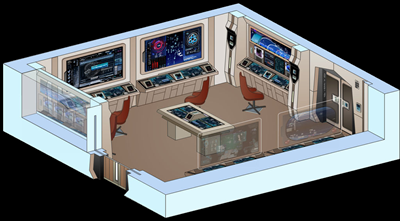 The Weapons Control Room aboard the Saratoga-C serves as the primary tactical hub for the management and oversight of the ship's entire offensive and defensive suite. Functioning as a specialized annex of the Tactical Department, this facility provides a high-resolution interface for the precise calibration of weapon frequencies and the coordination of the vessel's rapid-fire defensive and offensive systems. The room’s layout is designed for maximum situational awareness, featuring a series of wall-mounted strategic displays and angled control consoles that provide real-time telemetry on energy levels and targeting sensor accuracy for all weapon banks.
A central, free-standing tactical table acts as the room's focal point, offering a three-dimensional holographic representation of the surrounding environment and current engagement envelopes. Surrounding this central hub are multiple dedicated duty stations, each equipped with ergonomic seating and high-capacity data terminals, allowing personnel to work in unison during complex combat maneuvers. The facility is further enhanced by glass-enclosed equipment racks that house localized redundant processors and power relays, ensuring that all weapon systems remain operational even if main power to the Bridge is disrupted.
Access to the Weapons Control Room is secured by heavy biometric-locked doors, given the sensitivity of the offensive systems managed within. The interior architecture utilizes reinforced bulkheads and integrated overhead lighting, maintaining a functional and focused environment for the tactical crew. In addition to active combat management, the room is used for daily diagnostic sweeps of all emitters and launchers and for conducting simulations of advanced firing patterns.
Phaser Arrays
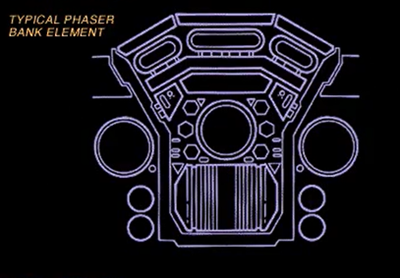 The U.S.S. Saratoga-C, an Intrepid II Class vessel, functions as a smaller cousin to the Century Class and utilizes the same Type XVIII Phaser Arrays as the larger vessel. Despite this, Saratoga's Phasers are severely limited by the ship’s power generation capabilities and fire at a fraction of the power available on larger explorers.
 The primary directed-energy weapon utilizes the rapid nadion effect via fushigi-no-umi superconducting crystals to liberate and transfer strong nuclear forces. Each array consists of multiple emitter segments mounted in a structural honeycomb channel, capped with a trapezoidal mass of crystal. These emitters are submerged within the vehicle frame and protected by Phaser-transparent hull coatings, with supersonic regenerative cooling systems managing the significant heat generated during fire.
Activation is managed by the Electroplasma System submaster flow regulator, which channels plasma through hafnium tritonide-reinforced prefire chambers. The ship's computer utilizes the Threat Assessment/Tracking/Targeting System to manage firing solutions, establishing power levels and discharge configurations across over 3,500 unique combat maneuvers. To optimize performance, these arrays support both continuous stream and pulse-fire modes. While historically restricted by Warp Fields, the Saratoga-C employs Annular Confinement Beams to enable phaser engagement at Warp speeds. Furthermore, the system incorporates frequency-shifting firing patterns to prevent hostiles from adapting to the weapon's energy signature. Despite being a smaller cousin to the Century Class, the Saratoga maintains a formidable tactical loadout, allowing it to perform effectively in engagements that its "light explorer" classification might otherwise suggest it should avoid.
Transporter
Overview
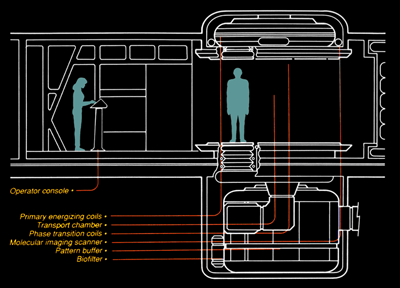 The Transporter, originally conceptualized by Emory Erickson, allows personnel to travel from the U.S.S. Saratoga-C to other locations without the need for shuttles or other small craft. Starfleet transporters operate by dematerializing a targeted object, transforming it from matter into energy. This energy is then transferred to another location via a narrow-focus subspace carrier wave and rematerialized back into matter, exactly as the subject appeared when they stepped onto the platform. The entire process for Saratoga's systems typically takes approximately five seconds from start to finish.
With an operational range of 100,000 kilometers, the Personnel Transporter is the system most familiar to the crew. Used primarily for humanoids, it can also transport cargo and personal property. Emergency Transporters are also installed aboard the Saratoga-C; these systems are incapable of beaming individuals onto the ship and are reserved for shipwide evacuation, possessing a limited range of 15,000 kilometers. Cargo Transporters, located in various cargo bays, also boast a 100,000-kilometer range. However, because they are not rated for quantum-level operations, they do not function at the molecular level and cannot safely transport living beings. In extreme crises, Cargo Transporters can be modified to transport humanoids, though their functionality remains more limited than standard personnel systems.
Each transporter type utilizes similar core components. Energizing and transition coils convert the subject from matter into energy, while the energizing coils generate the annular confinement beam, which creates the spatial matrix where dematerialization occurs. A secondary field holds the subject within the annular confinement beam to prevent field disruption, as any instability would cause a massive energy discharge lethal to the subject. Emitter and receiver arrays located on the Saratoga-C’s outer hull handle the transmission and reception of these signals.
The energy pattern is held by a magnetic pattern buffer during transit, allowing Doppler compensators to adjust for relative motion between the ship and the destination. For safety, each unit is outfitted with multiple pattern buffers that can store a pattern for a short period. If the buffers malfunction or hold a pattern for too long, the subject may suffer adverse medical effects. A transporter specialist can preserve a pattern by transferring it between buffers, provided the system maintains power; however, the pattern is lost if the buffer loses power, is reset, or undergoes a system upgrade.
Molecular imaging scanners map the target on a subatomic level, while targeting scanners locate the destination or the person beaming aboard. During this process, biofilters scan every pattern for bacterial and viral agents, contraband, or unauthorized weapons. Should a risk be detected, the software filters it from the matter stream. While a specialist can override this screening, it requires explicit command authorization.
Transporter specialists monitor the system from control stations, having received extensive training to mitigate the risks of interference and malfunction. Both cloaking devices and active deflector shields prevent safe transporter usage. Accidents are rare, as the management software incorporates multiple redundancies. When anomalies occur, specialists must work rapidly to prevent improper materialization or pattern loss. During every transport, a Transporter ID Trace is sent within the subspace carrier wave to document the event and assist in troubleshooting.
Before transport, a lock must be established using targeting sensors. Because Saratoga-C's sensors are subject to external interference, transporters are similarly limited. The system can attempt to penetrate interference by increasing power to the transporter, which tightens the annular confinement beam and increases component sensitivity. Pattern enhancers and isolinear tags may also be used to stabilize the signal lock. Shields provide the most significant interference; strategies to bypass them include matching shield modulation, emitting radions or tachyons toward the target’s shields, or attempting to penetrate a shield window.
Transporter Room
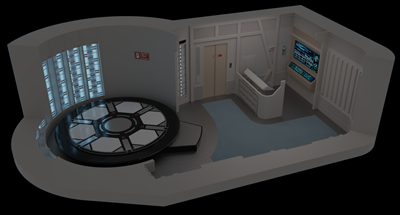 Overseen by a transporter specialist, each room includes a transporter chamber with a corresponding platform. The platform is fitted with six emitter pads, numbered clockwise from the right front. If cargo or heavy equipment requires transport, the central section of the platform is utilized.
Opposite the chamber, the specialist works from a display console located within a semi-enclosed alcove on an elevated platform. A large monitoring console attached to the bulkhead provides a system status overview and allows for fine control. During complex operations—such as emergency medical beaming or large-scale evacuations—a second technician can work in tandem from this wall console.
Entry to the room is provided by a single door leading to a staging area for away team preparations. Across from the entry is an access door to an equipment bay and storage lockers for away team supplies. The circuitry bay within this anteroom maintains primary hardware, including the biofilters, pattern buffers, and the primary computer interface. Technicians use this area to quickly access hardware for modifications or repairs; for security, this area is locked to prevent access by unauthorized personnel.
Categories: No categories found